
Identity Security
Why one in seven access rights poses a security risk (and how to fix it): The State of Identity Governance

Identity Governance and Administration (IGA) has become a critical pillar of enterprise cybersecurity. It's the framework of policies and technologies that ensures the right individuals have the right access to the right resources at the right times, and for the right reasons. However, insights from the 2025 State of IGA Survey (by CyberArk) reveal a significant disconnect between the strategic importance of IGA and its practical implementation. The findings underscore that for a vast majority of organizations, IGA remains a manual, inefficient, and risk-laden endeavor, struggling to keep pace with complex IT environments and mounting compliance pressures.
A deep dive into the report's findings, which surveyed hundreds of identity management leaders, exposes several critical pain points that demand immediate attention. Despite the long-standing availability of IGA solutions, organizations are mired in legacy processes that hinder security, impede productivity, and exhaust valuable resources.
The Weight of Compliance and Manual Reviews
One of the most significant challenges highlighted by the survey is the laborious nature of User Access Reviews (UARs). Driven by a complex web of regulatory requirements, UARs are a non-negotiable activity for nearly all companies. A staggering 99% of organizations conduct these reviews to satisfy compliance mandates such as Sarbanes-Oxley (SOX), GDPR, PCI-DSS, and ISO 27001. The challenge is compounded by the sheer volume of these obligations; over half (55%) of companies must adhere to five or more different regulatory frameworks. Furthermore, 84% of leaders expect these compliance duties to become even more extensive in the coming years.
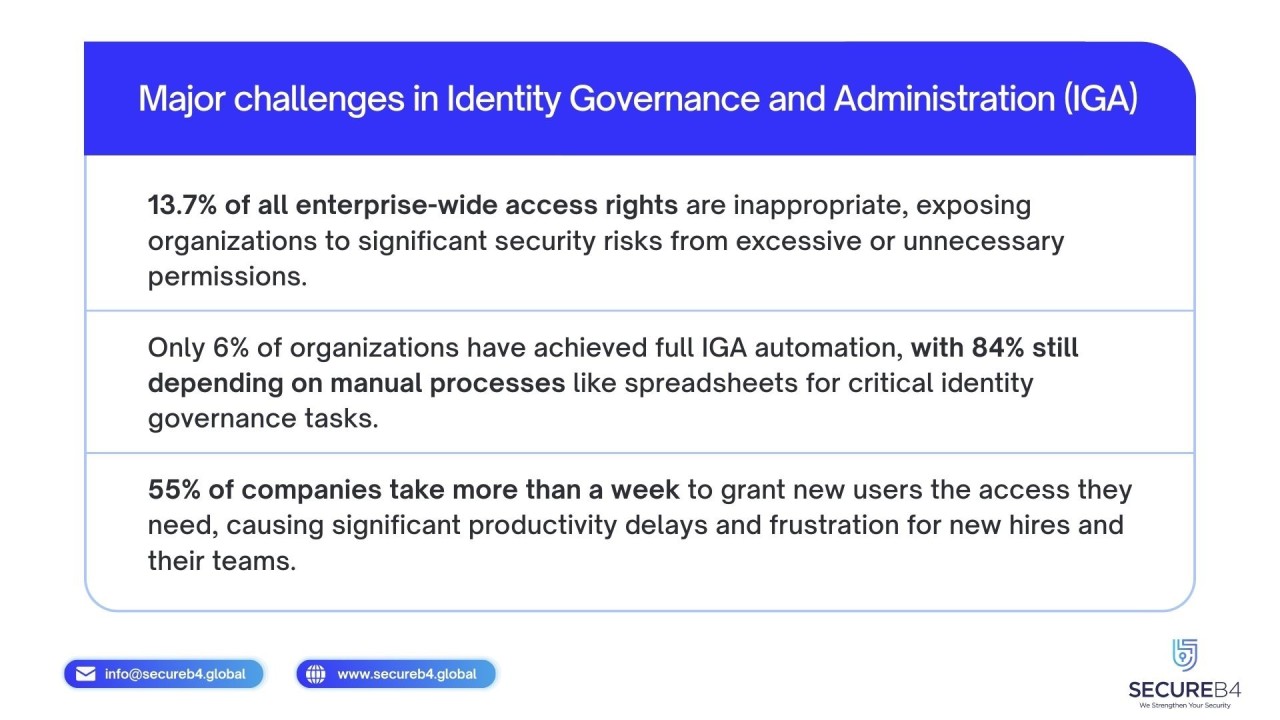
Despite their importance, the execution of UARs is overwhelmingly manual. The survey reveals that 84% of organizations depend heavily or entirely on manual methods like spreadsheets and IT tickets for their IGA processes. Only a meager 6% have managed to achieve full automation. This manual approach makes access reviews a resource-intensive ordeal that involves compliance managers, application owners, and people managers spending considerable time compiling and validating massive amounts of entitlement data. This audit fatigue is palpable, with 39% of identity leaders stating they struggle to keep up with the demands. In highly regulated sectors like healthcare, this figure jumps to 56%.
The core of this problem lies in the difficulty of integrating legacy IGA systems with modern IT infrastructures. An overwhelming 82% of leaders point to integration complexity, especially with cloud and SaaS applications, as the primary roadblock to automation.
The Drag on Productivity: Slow User Provisioning
Effective user lifecycle management is fundamental to both security and operational efficiency. However, the survey data shows that provisioning—granting new users the necessary access to begin their work—is a major bottleneck. A majority of organizations (55%) report that it takes more than a week to fully provision a new employee or contractor. For 29% of companies, this delay extends to more than 11 days.
This latency has a direct and measurable impact on productivity. Every new employee loses a week or more of productive time simply waiting for access, a significant source of frustration for business managers eager to get their teams operational. Attempts to bypass this delay often lead to another serious problem: over-provisioning. In a rush to grant access, users are sometimes given more permissions than they need, which inadvertently introduces security vulnerabilities based on the principle of least privilege. This issue is exacerbated by the fact that 90% of organizations admit they have struggled to accurately define and maintain the business roles that would enable faster, more automated provisioning.
The Pervasive Risk of Inappropriate Entitlements
Perhaps the most alarming finding is the widespread prevalence of inappropriate access. The survey reveals that, on average, organizations identify 13.7% of all enterprise-wide entitlements as inappropriate during access reviews. This means that roughly one in every seven access rights is excessive, unnecessary, or belongs to an orphaned or dormant account.
This phenomenon, often called "privilege creep," is a serious security risk. In midsize to large enterprises, a 13.7% rate of inappropriate access translates to thousands or even tens of thousands of risky entitlements that must be revoked quarterly. These excessive permissions create a vast attack surface, providing a broader field of opportunity for cybercriminals. If an over-privileged account is compromised, an attacker can gain expanded access to sensitive systems and data, facilitating lateral movement and data exfiltration. Over half (52%) of organizations reported that more than 11% of user permissions reviewed were excessive, highlighting the scale of the threat.
The Path to Modern, Automated Governance
The 2025 State of IGA Survey paints a clear picture: legacy IGA systems and the manual processes they perpetuate are failing to meet the demands of the modern enterprise. The path forward requires a strategic shift toward modern, automated IGA solutions designed for today's cloud-centric world.
Organizations must move away from the manual, ticket-based systems of the past and embrace automation to handle the scale and complexity of identity management. This includes :
Automating User Access Reviews to reduce audit fatigue and ensure continuous compliance without the massive manual effort.
Streamlining Provisioning and Deprovisioning to accelerate employee onboarding and immediately revoke access upon departure, minimizing security gaps.
Implementing Role-Based Access Control (RBAC) by investing in tools that can help define, maintain, and manage roles effectively.
Adopting a Zero Trust Mindset by continuously verifying access and enforcing the principle of least privilege to shrink the potential attack surface.
The report ultimately serves as a call to action. Identity governance is no longer a mere operational task but a strategic imperative that underpins an organization's security posture, compliance adherence, and business agility. To navigate the evolving threat landscape and unlock workforce productivity, leaders must prioritize the modernization of their IGA strategies and invest in the automated, intelligent, and scalable solutions needed to secure their enterprises.
Struggling with slow, manual user access reviews and provisioning delays? SecureB4’s advanced Identity and Access Management (IAM) platform automates the entire user lifecycle, from onboarding to offboarding. Our solution eliminates cumbersome processes, empowering you to conquer compliance challenges and slash security risks posed by excessive permissions.
Our behavioral IAM solution enhances security with risk-based access controls and robust MFA support, freeing your IT teams from audit fatigue. Empower your workforce with immediate, appropriate access and transform identity governance from a bottleneck into a strategic business advantage.
Ready to strengthen your security? Get a free consultation today:
Email: info@secureb4.global
Website: www.secureb4.global
Follow: Pradeep Karasala (PK) | Chandra Sekhar D. (Chandra)
Follow our page SecureB4